When a product is found to be dangerous, two types of recalls can be issued: voluntary and mandatory. A voluntary recall happens when a manufacturer proactively removes a product from the market without being ordered to do so.
A mandatory recall happens when a government agency, like the Consumer Product Safety Commission or the FDA, orders it because a company has not addressed a known safety problem.
The main difference is who starts the recall and what it says about the company’s actions, which can directly affect your product liability case.
In this article, we break down the main differences between voluntary and mandatory recalls. We will also discuss how they can impact liability in a product-related injury case.
What Is a Product Recall?
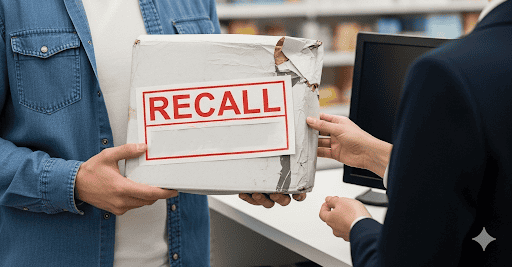
A product recall is a request to return, repair, or replace a product after a recalling firm has determined it poses a safety risk or fails to meet regulatory standards. Between the years 2012 and 2024, the Food and Drug Administration (FDA) has recalled 94,288 products.
Recalls can apply to food, medical devices, toys, vehicle parts, and almost any other consumer product.
What Types of Products Are Most Commonly Recalled?
Food recalls are among the most frequent and urgent. The Food and Drug Administration (FDA) oversees recalls of food products, dietary supplements, and cosmetics when they are found to pose a risk to public health, such as contamination with bacteria like Salmonella or E. coli, or undisclosed allergens that could trigger life-threatening reactions.
The FDA also oversees recalls of medical devices and prescription drugs. The Consumer Product Safety Commission (CPSC) handles recalls of household products, toys, electronics, and furniture.
The National Highway Traffic Safety Administration (NHTSA) manages vehicle and auto part recalls.
| Voluntary Recall | Mandatory Recall | |
|---|---|---|
| Who initiates it | The manufacturer or distributor | A government agency (CPSC, FDA) |
| Why it happens | The company identifies a defect and acts proactively | The company failed to address a known safety issue voluntarily |
| Speed of action | Often faster — the company acts on its own | Slower — follows extensive government investigation |
| What it signals | The company knew or should have known about the defect | The company resisted action or concealed known dangers |
| Legal impact | Supports negligence or strict liability claims | Can support gross negligence and punitive damages |
| Possible penalties | Varies — the company may avoid fines if acting in good faith | The company often faces fines and government penalties |
Voluntary Recalls
A voluntary recall, also known as a firm initiated recall, occurs when a manufacturer or distributor chooses to voluntarily recall a product without being formally ordered to do so by a government agency. They do this to minimize liability and maintain customer trust.
These are the typical steps in a voluntary recall:
- The company that makes or distributes the product identifies a defect or safety issue
- The company reports it to the appropriate government agency, such as the Consumer Product Safety Commission (CPSC)
- The company cooperates with the government agency to help them address the issue
- Questionable products are removed from the market
- Consumers are notified by press releases, social media posts, emails, website postings, or other means
- Consumers may be offered a refund, repair, or replacement of the item
Voluntary recalls can happen quickly, which may reduce the number of injuries and incidents. However, just because a recall is voluntary doesn’t mean it’s any less serious.
The Impact of Voluntary Recalls on Product Liability Cases
A voluntary recall may demonstrate that a company is taking consumer safety seriously. However, this action does not absolve the manufacturer from responsibility for injuries caused by the defective product.
Courts may view a voluntary recall as proof that the company knew or should have known of the danger. This evidence can be used to support claims of negligence or strict liability.
Additionally, if a company delays issuing a voluntary recall, it may be held more accountable for injuries occurring during that time.
Mandatory Recalls
A mandatory recall is ordered by a government agency after a company fails to address a known safety issue voluntarily.
Agencies like the CPSC or the FDA have legal authority to compel companies to recall dangerous products, particularly those linked to serious adverse health consequences, when voluntary action is not taken or found to be insufficient.
Mandatory recalls are usually done as a last resort. They often follow extensive investigation and are a clear indication that the product poses a serious risk.
How Mandatory Recalls Affect Product Liability Claims
A mandatory recall typically demonstrates that the manufacturer failed to act in a timely or responsible manner. This can strengthen your product liability case, suggesting gross negligence or willful disregard for consumer safety.
Your lawyer may be able to demonstrate that a company resisted a recall or concealed known dangers. A court may award punitive damages in addition to compensatory damages.
Mandatory recalls often lead to the company being fined and penalized. This can further support your argument that the product was unreasonably dangerous.
How a Personal Injury Attorney Can Help After a Recall

Have you or a loved one been harmed by a recalled product? Whether the recall was voluntary or mandatory, a lawyer can be essential to protecting your rights and helping you pursue compensation.
Investigating the cause of your injury
Your lawyer will thoroughly investigate whether the product was defective and whether the defect caused your injuries. He or she may work with experts to analyze product design, manufacturing processes, and recall documentation.
Determining liability
Identifying the liable party is critical in any personal injury case. Your attorney will investigate the recalling firm and determine whether the manufacturer, distributor, or retailer bears responsibility for your injuries.
In product liability cases, multiple parties may be responsible, including:
- Manufacturers
- Distributors
- Retailers
The type of recall may also indicate whether the company acted negligently or tried to hide a known risk.
Building a strong legal claim
An experienced product liability lawyer will gather essential evidence like:
- Medical records
- Purchase receipts
- Product packaging
- Recall notices
This evidence will be used to build a solid personal injury case on your behalf.
Pursuing maximum compensation
Personal injury attorneys can help you recover damages for:
- Medical expenses
- Lost income
- Pain and suffering
- Long-term disability or disfigurement
Hold negligent companies accountable
Importantly, pursuing legal action sends a message to corporations that safety should always come first. Whether a recall is voluntary or mandatory, your case can contribute to public awareness and safer product standards.
Understanding the Difference Between Class Action and Individual Lawsuits

As a victim of a defective product, you may be able to recover compensation through a class action lawsuit or an individual personal injury claim. Let’s discuss the difference between the two.
Class action lawsuits
A class action is filed on behalf of a large group of people who have been similarly harmed by the same product. These cases often seek collective damages for things like medical expenses, refunds, or punitive damages.
A potential downside of a class action is that a settlement usually gets split among all the people involved, so individual payouts can be small.
Individual lawsuits
An individual lawsuit is filed by a single person or family and is often the best option when your injuries are severe. These cases allow for compensation tailored directly to you specifically, including pain and suffering and future medical care.
The payout of the settlement is often higher because it is not divided among multiple parties.
Injured By a Recalled Product? Our Law Firm Is Here to Help
At Fielding Law, we are committed to holding manufacturers accountable for unsafe products. Whether the recall was voluntary or mandatory, you deserve answers and fair compensation. Our legal team can guide you through the complex legal process and help ensure your rights are protected.
A personal injury lawyer can help you figure out who is at fault, explain your legal options, and work to get you fair compensation. We take all personal injury cases on contingency, which means you don’t pay any upfront costs or fees.
If you or a loved one has been injured by a recalled product, don’t wait to act.
Contact Fielding Law today to speak with a skilled attorney and get the justice you deserve.
Frequently Asked Questions
1. What is the difference between a voluntary and mandatory recall?
A voluntary recall happens when the manufacturer or distributor decides to pull a product from the market on their own, usually to reduce liability and maintain consumer trust.
A mandatory recall is when a government agency, like the Consumer Product Safety Commission or the FDA, orders the company to recall the product because it did not address a known safety problem. In both cases, the product is considered a serious risk to consumers.
2. Does a voluntary recall mean the company is not responsible for my injuries?
No. A voluntary recall does not shield a company from legal responsibility. Courts may even see a voluntary recall as proof that the manufacturer knew or should have known about the problem.
3. Can I sue if I was injured by a product under a mandatory recall?
Yes. A mandatory recall can make your case stronger because it shows the company did not act quickly or responsibly. Courts may see this as evidence of serious negligence or ignoring consumer safety, which can help you claim both compensation and punitive damages.
4. How long do I have to file a claim after a product recall?
The time limit for filing a product liability claim depends on your state. If you wait too long, you could lose your right to compensation.
If you or someone you care about was hurt by a recalled product, whether the recall was voluntary or mandatory, talk to a personal injury attorney as soon as you can to protect your rights.
5. Should I join a class action lawsuit or file an individual claim after a recall?
It depends on how serious your injuries are. In a class action lawsuit, the settlement is shared among everyone involved, so each person usually gets a smaller amount.
If your injuries are severe, such as high medical bills, lost wages, or long-term disability, filing your own personal injury claim usually means you can get more compensation that fits your situation.