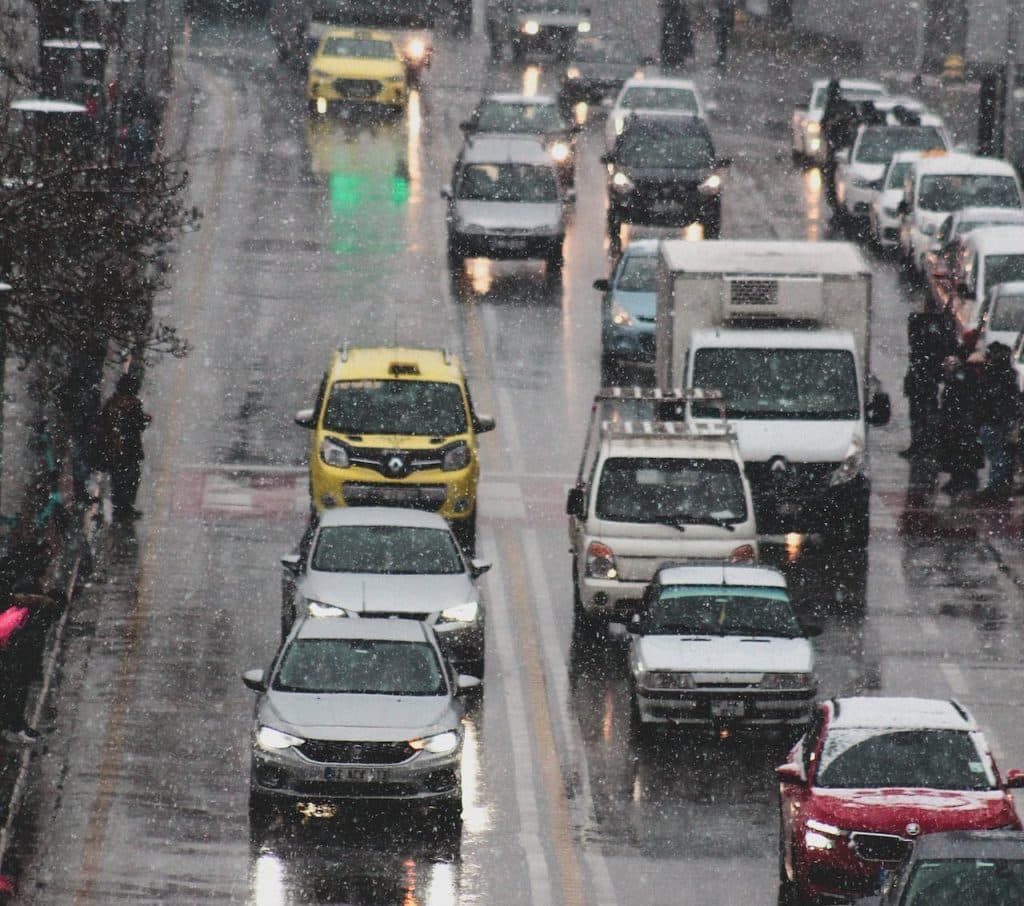
Winter weather can bring unpleasant road conditions. Hazards such as ice and snow can make driving a challenge, particularly for large vehicles.
In 2021, a total of 523,796 large truck accidents occurred across the United States. If you or your loved ones have been injured in an accident with a big rig, you know how devastating the consequences can be. It would surely be better if we could avoid accidents before they happen.
Following a few safety guidelines can greatly decrease our chances of being involved in an accident with a tractor-trailer. Even minor changes in our driving behavior can help all of us to get to our destinations safely.
14 Driving Tips for Sharing the Road With Trucks in the Winter
Winter weather can exacerbate some of the issues that 18-wheelers present to other vehicles on the road.
Below are several safe driving tips for cars traveling in close proximity to large trucks, and many of these tips are applicable in any season:
- Watch out for blind spots: The main areas to watch out for are on the sides of the truck, directly in front of or behind the truck, and along the right side of the cab. If you cannot see the truck’s mirrors, it is likely that the driver cannot see you. This is even more true in winter when snowy weather can make visibility more difficult.
- Don’t follow too closely: When you are following a larger vehicle, it is unlikely that you can see what is in front of that vehicle. Make sure to leave enough space between you and the back of the truck so that the driver can see you in his or her mirrors. In winter weather, trucks may not slide on ice as easily as smaller vehicles, and leaving proper space will help ensure that you will not have a collision.
- Keep yourself visible: Making sure that other drivers see you is especially important in winter weather and with 18-wheelers nearby. Depending on the time of day or the colors of it, a car can become camouflaged by snow, making it difficult to spot by other drivers. Keeping your lights on even during the daytime can be one way to increase your visibility for those with whom you are sharing the road.
- Use your signals correctly: Trucks have longer vehicles and need to know if the nearby drivers plan to turn, overtake, change lanes, or exit a highway. By always using your blinkers, you give other drivers the chance to anticipate your actions and react accordingly. If you need to drive slowly, use your flashers to help give semi-trucks the chance to pass you safely.
- Anticipate wide turns: Semis require more space to turn. For example, trucks need to swing out much farther than the average vehicle in order to avoid obstacles when turning right. Always give a larger vehicle extra space, especially when snowplows may have created drifts along the sides of the road, limiting maneuverability.
- Use caution when merging: Since large trucks require more time to stop, dangers arise when traffic goes down from 2 lanes to a single lane. It may be tempting to speed up and merge right in front of the truck, occupying the empty space between that and the leading vehicles. However, this could lead to a multiple-car pile-up, especially in icy conditions.
- Pass only when safe: After making sure you are visible in the truck’s mirrors, signal your move into the left lane and then accelerate to pass the truck safely. Never pass on the right side of a truck, though, as this lessens visibility.
- Use your windshield wipers: Even if it is not snowing or raining that hard, it is important to use your windshield wipers to an adequate degree. Trucks often shower neighboring cars with a heavy amount of precipitation due to their unique structure. Being ready to use your wipers can ensure that you never lose visibility.
- Keep yourself safe: Buckle up. While it may seem obvious, forgetting to put on your seat belt can greatly increase your risk of injury in the event of an accident. Being buckled up can even help you maintain control of the vehicle in icy conditions.
- Don’t drive when tired or under the influence: Driving when overtired or under the influence of drugs or alcohol is never a good idea since such conditions decrease your reaction speed, putting other drivers at risk. When driving near large trucks, having impaired judgment can prove fatal.
- Be patient with road conditions: When the roads are affected by ice or snow, it is essential to drive at an appropriate speed, which may be significantly slower than normal. In addition, windy weather in the winter can cause semi-trucks to weave into nearby lanes. Being alert and not in a hurry can help protect you from danger.
- Remember which lanes to use: On 4-lane and 6-lane highways, trucks are often required to stay in the right lane except when passing. Therefore, if you see a truck in the center or left lane, the driver is likely attempting to pass another truck. Keeping this in mind will remind you to remain visible and to yield while a truck is maneuvering.
- Avoid the axles: Driving near the wheels, or axles, of a semi-truck can be dangerous, especially in winter weather. Big temperature changes can cause added strain on tires, and being next to a truck’s axles in the event of a blown tire can be very dangerous.
- Stay focused: While it may be challenging to share the road with big trucks during wintery conditions, it is possible to do so safely when we stay alert. Avoiding distractions, such as the radio, GPS, cell phones, or eating, is vital to give yourself the time you need to react.
Following these safety tips can help you successfully share the road with trucks during winter. However, what should you do if you are involved in an accident with a large truck?
Year-Round Rules for Driving Near Big Trucks
Winter weather raises the stakes, but these habits matter in every season:
- Stay out of the no-zones. Trucks have large blind spots directly in front, directly behind and along both sides, with the biggest one on the right. If you cannot see the driver’s face in the truck’s mirror, the driver cannot see you.
- Pass on the left, and pass decisively. Do not linger beside a truck. Before you move back over, wait until you can see both of the truck’s headlights in your rearview mirror.
- Leave room to stop. A loaded tractor-trailer at highway speed needs roughly the length of almost two football fields to stop, far more than a car. Never cut in front of a truck and then brake.
- Watch for wide right turns. Trucks often swing left before turning right. Never try to squeeze past on the right.
- Do not tailgate. Keep at least four seconds of following distance so the driver can see you and you can see the road ahead.
- Stay focused and sober. Put the phone away, and do not drive drowsy or impaired.
How Fielding Law Can Help
As personal injury accident attorneys, we know that truck accidents can be especially devastating for you and your loved ones. Property damages are usually major, and hefty medical bills could start piling up in the aftermath of an accident with a big rig.
Fielding Law wants to help you lighten your load. If you were injured in a truck accident in winter weather conditions, we want you to get the compensation you deserve.
Schedule your free consultation with Fielding Law’s personal injury lawyers. Send us a message or call our 24-hour telephone line at (877) 880-4090.